The Family
Journal Writing
Over the years, several members of the Harris family kept personal diaries.
Still on record today, the Harris family diaries offer us a glimpse into the
past and provide us with a special inner perspective of life at Eldon House.
Journal writing has been a means of personal expression for centuries and spans
across many cultures. A journal or diary can be many things; it can act as a
description of daily events, a response to and reflection of life's events, or
an expression of understandings and emotions.
These two entries are from Anthony Little, whose mother Lucy Little was one of
the last Harrises to live in Eldon House.
Memories of Lucy Little
June 24, 1913 to August 10, 2001
By Anthony Little
It is most fitting that we gather here today among the beauty and austerity of
this impressive building with the sun streaming softly and with changes to its
colour through its magnificent Tiffany windows. This was Lucy's family's home
church. The front pew - north side - centre aisle had the name "Harris" on it
long after there were no longer Harrises with that surname still sitting in it.
Lucy sat many, many times in it, though. Listening to the sermons of George
Luxton, Charles Brown, Ken Keefe and a whole host of others whom I never met.
Lucy was gifted with many things, but a singing voice was not one of them. Those
in the pew with her were happier if she just mouthed words during the hymns. She
usually arrived with her own bible. In later years, she carried a French bible.
In her last years of attendances, she brought an Italian bible. She would read
along in those bibles as the lessons were being read in English.
I imagine Lucy and her brothers, Robin and George, running up Fullarton Street
from behind the high fence at Eldon House late for the 11 o'clock service. None
would be embarrassed by lateness. Each would never hesitate to stride
purposefully to their pew at the front of the church. They would settle as have
we and the show would start.
For Lucy the show started two blocks from here.
Amelia Lucy Ronalds Harris was born on June 24, 1913. The Feast of Saint Jean
Baptiste. A good day for a start.
Lucy and her father did not meet until she was through the terrible twos. He was
a mining engineer and had been in Juneau, Alaska on assignment. Her older
brother, George, had arrived approximately four years earlier. Where her father
Ronald Harris might have been then is not known to me. Robin filled the
complement four years later.
You must imagine Eldon House at that time. It was, unlike today [2001], hidden
behind a well-kept eight-foot high grey wooden fence. Today's open wrought iron
fence provides a great vista for the house and its setting, but then it was much
more mysterious. One entered through a gate and under a peaked roof. One could
only imagine what was inside the fence. High on a hill, overlooking the forks,
it presented an imposing position. "Location, location, location" as the
realtors would say. The hill down to the flats was crisscrossed with a
descending series of paths. At the bottom, there was a pool, grass tennis court
and a couple of holes of golf. From that house, family members would take off on
their various ventures. The Harrises were travelers of note and vigour.
Lucy attended Lord Roberts Public School. I would have thought Talbot Public
School to have been closer. It is reported she gleefully, at age six, hitched a
ride to school on icy winter mornings by clinging to the tines of the pitch
forks jammed into the back of the municipal garbage trucks. She was known as
little Lucy Harris.
In Grade 9, she went for one year to Central Secondary School and then to
Montreal to Miss Edgar and Miss Cramps School for Young Ladies for the balance
of her high school period.
She then spent a year or so at a school in Paris. It was never explained to me
what she actually did during that year, but I have been able to piece together
that she was living with a woman who had a salon to which the mighty and famous
repaired on a regular basis. She was being finished. [I am not certain the
process was complete. In my view, Lucy continued to be a work in progress
through the balance of her life.] I can see Lucy with F. Scott, Morley and Zelda
as well as lesser-known French middleweights, princes and nobles, �migr�s,
mistresses and courtesans although I cannot confirm any accuracy of any of that.
Lucy was able to keep her mouth shut. I think she just had too good a time to
report the detail.
In those days, women did not go as automatically to university. Lucy probably
should have. She valued education highly. I suspect she had assimilated much of
what she would have received through the osmosis of the education she received
in her own home.
As the pictures will show, she was really quite pretty.
In 1940, she married Frank Little. I would hope that there was more to that than
a need for symmetry; however, it is a fact that Little Lucy Harris did become
Little Lucy Little. Their wedding date was February 24. I would have thought
that a strange choice. It is reported that Frank appeared in the early hours of
the 23 below her window in the snow from whence he serenaded her on the tin
whistle until banished summarily from the premises by his about-to-be
mother-in-law who suggested he must be drunk. My bet is that he was.
I appeared in 1942 and Frances three years later. George joined the team much
later. Three kids in three different decades of her life. New homes each time
one of us was to appear.
My theme today is friendship. My theme will be based on our mother and her life.
You will all have to bear with me as I work through this. I will not apologize
for its length. It will be as long as it must. This is Lucy's day and it is a
day of celebration. I really don't want to miss anything.
You will have noted that "bearing the pall" today in, at least, a ceremonial
fashion are a set of remarkable women. We think this approach to be an
innovation of which our mother would be pleased. Each represents an interest of
our mother during her life. Each is a friend. Lucy could not be considered a
feminist although she could represent the attainment of some goals of that
movement. I believe Lucy to have been an equalist -- there is such a word. Lucy
was her own person. She never felt constrained in what she might wish to do. She
just did it.
Lucy was capable of being interested and knowledgeable in many fields. She was
an athlete of quality. She was an indefatigable traveler. She was a puppeteer, a
dog breeder, a gardener, a landscaper, a hobby farmer, a successful and totally
unconscious bridge player as well as a wife and mother of inspired devotion.
But, most of all she was a friend who inspired loyalty.
Lucy was a founding member of the Maycourt Club of London. This organization
started with a group of friends most of whom Lucy outlasted. Her particular
interests were marionettes. She discovered an organization known as the
Puppeteers of America. [Quite a grand name I have always thought.] She joined
and then became a constant attendee at its conferences. I was her traveling
companion. Like that Paul Simon song. My travelling companion was but nine years
old, the child, etc. We went to sensational events. Oxford, Ohio; St. Paul,
Minnesota, Chapel Hill, North Carolina; Baton Rouge, Louisiana etc. etc.. We met
famous people -- all of whom became Lucy's friends. She was the only Canadian
member for many years. Rufus Rose, Jim Henson, Martin Stevens, Shari Lewis were
just a few of the names. Nancy Henke is one of this group, and she has been a
good and constant friend for Lucy who has come many times over the past years
(including this year) and today from her home in Michigan.
As a young girl, Lucy had a dog, a Bedlington terrier, Smokey, who could climb
trees. He had come from England in some fashion. When we were kids, she decided
that she would reprise that plan. A second Smokey came in a crate by Air Canada
to Toronto and emerged from the crate to sit on my father's shoe. He was seldom
far from that shoe for quite a while. This dog was a genius. He and I shared a
love for Merla Mae ice cream. We went there often. I got a 25-cent cone. He got
a five-cent cone. We would take one home to Mrs. Ross, our cleaning lady. Mrs.
Ross said her teeth weren't up to the treat. Mrs. Ross rode in the back. Smokey
in the front. I held the cone for him as we drove along. The guy at the Merla
Mae said that if my dog was smart enough to eat an ice cream cone, I should buy
him the 15-cent size. Through the dog connection, Lucy met Sally Dekold and her
husband Robert who breed and show Bedlingtons from their kennel in Livonia,
Michigan. Smokey was a made man through the Kennel Club. Lucy was in the kennel
business. We had lots of dogs; Lucy and Sally had lots of fun. They also
traveled together to Sanibel Island, in Florida for a bunch of years.
As a golfer, Lucy was quite a piece of work. She played well and ferociously. A
couple of stories: She was the club champion at the Hunt Club six or seven times
in three decades. She was runner up on more. [I honestly had hopes for Lucy to
able to shoot her age as she worked into her 70s, but a couple of strokes
overcame her. Strokes will affect strokes?] In the early 1960s, there was a
tournament at the end of the season for the male and female club champions of
each of the London area clubs. We have in our kitchen the trophy for the first
or second one of these events. A pepper grinder. I was her caddy in this event.
She started poorly. Down three after three on her home course. And a missed
drive and a three wood put her in a dismal mood on the par five fourth. The
leaves had fallen and it was damply drizzling. She was truly in a funk. She
threatened to walk off the course. Her third three wood was slightly better but
a bogey was in the works for sure. She was then going to be four down to the
other three women champions. And we couldn't find that third shot on the fairway
because of the wet leaves. Not a good time to be a caddy. I felt like Ian Woosnan's caddy must have felt recently. Well, we found the ball. As she stood
over her ball, she said, "this is nuts" took a deep breath and hit a seven iron
stiff to the pin. She then putted for her par, the hole and eventually the
match. It was then a good time to be a caddy.
Frank was not a good golfer. The fact that Lucy was such a good golfer made
husband and wife golfing a rarity. Both Frank and I were bemused as we
contemplated all of this. One evening, as I was reporting my day's time at the
Hunt Club to the two of them, I explained my strict adherence to the advantage
of the small burrowing animal rule and my all-time winter rules approach to golf
ball lies which allowed me to improve my lie. Lucy's observation was that:
"Anyone who would move his ball around would cheat on his wife." That is a
conversation stopper. Perhaps, from the perspective of a true golfer, it is also
an accurate assessment. Golfers are a strange lot.
Sue Hilton who is here today is one of the golfing friends. She has honoured
Lucy with her presence today in demanding circumstances. We are most grateful to
her and think that it must attest to the games of golf they have had and the
competitiveness between them and their friendship on the various courses they
have played together.
Beryl Ivey was a neighbour of Lucy's for many years. And a very close friend for
even more. She claims Lucy to have been a mentor. Frankly, I suspect that there
was a mutuality of mentorship. And I am not certain how one would characterize
the activity of the two of them trying to reshape kitchen silver in our basement
when one of them had allowed a piece or two to slip into the garbarator. Beryl
and Lucy were gardeners of quality and knowledge. They had different visions and
the settings each had to work with were also different. In my analysis, they fed
off each other and the results were dramatic and colourful.
Dorothy Hardy is a cross-over. She is a golfer and a traveler and a friend and
companion. Lucy and she traveled to Portugal and India, bought rugs, ate
sardines, played golf, drank wine and generally amused themselves. They also
spent time in Arizona and at various golfing events in the Muskokas. Dorothy is
a dropper in. She spent much time with Lucy. We might never have known of it
except for flowers being left or reports from Lucy's staff.
I find it interesting to observe Dorothy in this context for that is exactly
what Lucy used to do. Lucy would visit friends in homes or nursing homes on a
regular basis to bring a gift, a flower, a green bean or fresh green peas and
then she would be off to other events and activities. Just like her friend
Charlie Thompson. She was constant support for her mother and aunt during their
final illnesses despite the busy life she led. She also visited other friends
such as Marian Granger, Edith Cutler and many more. The irony was that Marian
was also at Meadowcroft after it first opened.
Mike King traveled with Lucy to China, Italy and various other locations. Lucy
and her mother were great golfing friends. Mike shared Lucy's love of gardening,
fabrics food and fun. Lucy could not sew, though.
These six women represent to us a cross-section of Lucy's friendships. Obviously
they are only a representation of the many friends who loved Lucy. I suspect the
number of bearers of the pall could be far greater. We are most appreciative of
the honour they do to Lucy and us by their agreement to act.
I have not yet mentioned baseball. Lucy was in the vanguard of audio technology.
She always wanted to be tied to a radio. It was invariably set to a baseball
game or the Texaco Metropolitan Opera broadcasts from Carnegie Hall. She had
portables and battery-driven radios long before they became as ubiquitous as
they now are. Her brother George was a St. Louis Cardinal Fan. She was Detroit
Tiger fan. Different leagues made their arguments less competitive although they
were both driven by statistics. Lucy could calculate batting averages long
before she could add or subtract.
A couple of stories:
When Christopher was around 11, Jessica, Lucy and Christopher were watching a
movie on one of those normal Sunday nights when Lucy would join us for Sunday
dinner. Betsy was working in the kitchen. The movie was a baseball story: The
Babe Ruth Story and we had all been most interested in it. While we waited to be
called to dinner, Christopher asked Lucy if she knew of Babe Ruth. When she
allowed that she did he expressed some scepticism. He went on.
"Did you ever see him play?" he asked.
"Yes, but later in his career." was her response.
Christopher again looked unbelieving. He suggested that she was making that up.
He went on to ask if she had ever met him. She said, slowly, that she had.
Christopher did not believe that and said so:
"Alright, Christopher, you asked for it. Book Cadillac Hotel. Detroit, Michigan.
September, 1935. Ladies Washroom. The Babe knocked me down coming out of a
stall."
In 1982, shortly after the death of our father, the rites of spring were upon us
and it was opening day in Toronto. Paul Beeston again arranged that we would be
treated to this spectacle. There was no question that Lucy was to be involved. I
hope that the Blue Jays won but I, frankly, can't remember. It was just before
Lucy was going to go off on an eight week trip to Australia with her brother,
Robin.
After the game, we repaired to Paul's office for some idle chat. There we met Al Widmar, the Blue Jays' pitching coach. For those of you who don't know Al, he is
very tall and lanky. He is about six feet three inches. Great sense of humour.
He was introduced to Lucy. They quickly started to talk about baseball. Lucy's
knowledge of the subject and Al's era was encyclopaedic. They were quickly
huddled in fast conversation. He was calling her Luce. That was not a name she
was usually called. Lucy seemed what the rest of us used. It was strange to see
them together since there was such a height variance. Their discussions were
quite animated.
It was then decided that we were going to all go out for dinner -- including Al.
He came back to Lucy and said that he had heard of the dinner plans and that he
was pleased that she was going to be part of that. He went on to suggest that
maybe after dinner they might get to dancing.
"Should that occur, Luce," he said, "Do you mind if I lead?"
As a mother, I could not expect more. She was a pure delight. I simply wish I
had been writing more when the stories were still coming. They were grand. One
example was a tale she told us as we were driving to Detroit for some artistic
event. I think Kaye Beeston was with us that day. It was a tale about a lady who
produced an unexpected child on the 18th fairway at the Old Hunt. Laying down
for a lying in before laying up. That is just one of many.
Lucy also fancied convertibles. What could be greater for a teenaged boy than a
sky blue convertible and a credit card and no instructions beyond that the use
of the card was only for gas. No food. How else could I ever have gotten to
Bangor, Maine?
As a grandmother, pure love and zaniness. Our kids had to wear ski goggles when
they decorated Lucy's trade mark hawthorn tree Christmas tree. Jessica, I
suspect you represent far more of Lucy than you will ever expect. Sunil,
Frannie's son, has a special connection with his grandmother for which he must
take credit because the distances between them and Lucy's last illnesses made
that more of a one way street than either would have chosen. Alex has the same
breed of dog which Lucy raised. We all, one way or another, had the same type.
We all have happy memories. Christopher correctly assessed Lucy when he told her
when she was expressing some frustration about growing older -- as we drove home
along the seventh concession one day: "Lucy, I don't worry about you, you are a
trooper."
Lucy has been brought through her final laps with the help of a newer group of
friends. Gloria, Fahima, Jocelyn, Florence and Sherry and all of the very kind
staff at Meadowcroft. These women and men have shown true friendship. They tell
us that they love Lucy. We think that to be great. Also another of those
symmetries.
Her niece, Catherine Harris, has said to me that Lucy never had a negative
thought. I am not entirely confident of that assessment. Lucy did have negative
thoughts. She once decked me with a super upper-cut from my bed where we were
standing, hammering something into the wall -- because of a bad thought profanely
expressed. She did not suffer fools gladly. She had her likes and dislikes. What
she never seemed to do was complain even when it might be thought she had a
cause to complain.
So there you have it. Lucy has played her last round, delivered her last egg,
pulled the strings on the last puppet, trumped Erie Ross ' last ace and dibbled
her last daffodil. In her last many years, she found another friendship with,
coincidentally, my best friend to whom Lucy and I are both most indebted.
I guess Al and the rest of us will have to lead ourselves from now on.
Memories of George Gibbons Ronalds Harris
August 27, 1910 to September 1, 2002
By Anthony Little
George Gibbons Ronalds Harris died on Sunday, September 1, 2002. At the time of
his death, he was a resident at Belmont House in Toronto where he was cared for
by a number of helpful, caring people who made every effort to ensure his
comfort and health. His passing was reflective of a long life although one in
which the last number of years had presented a challenge to him and to his
family. It is likely he was a victim of Alzheimer disease. His final years
carried little of the life and vivacity which he brought to his endeavours for
the first 80 years of his happy and occupied life. George, who carried a
handsomeness into his seventh stage, was married for 62 years to Norah Lyle.
They had two children, Adrienne and Lorna, each of whom proved the validity of
Mendel 's theories with their striking good looks reminiscent of their parents.
George was born in London, Ontario on August 27, 1910. He was the first of three
surviving children born to Ronald Harris and the former Lorna Gibbons, the
daughter of Sir George Gibbons.
Sir George had been knighted for his exemplary work for Canada in concluding
negotiations with the United States of America in the developing of the first
home-grown treaty between Canada and the United States. That treaty created a
mechanism for dealing with boundary waters between the two countries and the
creation of an International Joint Commission which would oversee these matters.
Whitehall had carried the negotiating ball in extra-country dealings for Canada
and the other Commonwealth countries until that moment in time. Sir Wilfrid
Laurier, then Prime Minister of Canada, chose George Gibbons as his point man
for these discussions. It was thought by the Americans that Canada would be a
likely pushover in these matters due to the Canadians ' lack of experience in
diplomacy and general lack of sophistication. Such was not the case for the
resulting treaty between Canada and the United States has proven a model of
efficacy and efficiency in the 100 years that have passed since its signing. It
continues to function into the 21st Century and serves both countries and their
border-connected communities extremely well while providing a larger context for
the control of country-wide problems such as hydro-electric power, global
warming, water resources and pollution.
As a first-born son, it would be an obvious choice for George to receive those
two names as his first given names. His third given name, Ronalds, was his
father 's mother 's surname. Lucy Ronalds had married George Harris, and their son
was Ronald Harris, George 's father. Receiving the name Ronalds as a third given
name brought a symmetry to these matters generally.
On the other hand, the fact that he had three names may represent a surfeit of
exuberance. It was something that his mother and father carried forward at least
to George 's next sibling. They also had started an apparent fixation on the
name, Ronald, or its variants.
Three years younger than George, Amelia Lucy Ronalds Harris, born June 24, 1913,
was immediately accepted as George 's friend and, he, as her protector. They
shared many common interests as they grew up at Eldon House, including an
abiding passion for athletics and sports generally. Consummate athletes from an
early age, they complemented each other and enjoyed each other 's company despite
the fact that Lucy was a girl and a younger one, too. George faced no
inhibitions in bringing Lucy along on his various pursuits and treating Lucy as
an equal despite their age and sex disparity. Lucy never thought of herself as
being anything other than an equal, too.
George 's second sibling was his brother, Ronald (Robin) Sutton Harris, who was
born on October 27, 1919. The Ronalds name was abbreviated in this instance;
but, the symmetry continued at least formally although Robin was always known as
Robin despite the christening records ' content and their possible argument to
the contrary.
George grew up behind the high grey board fence which surrounded the family 's
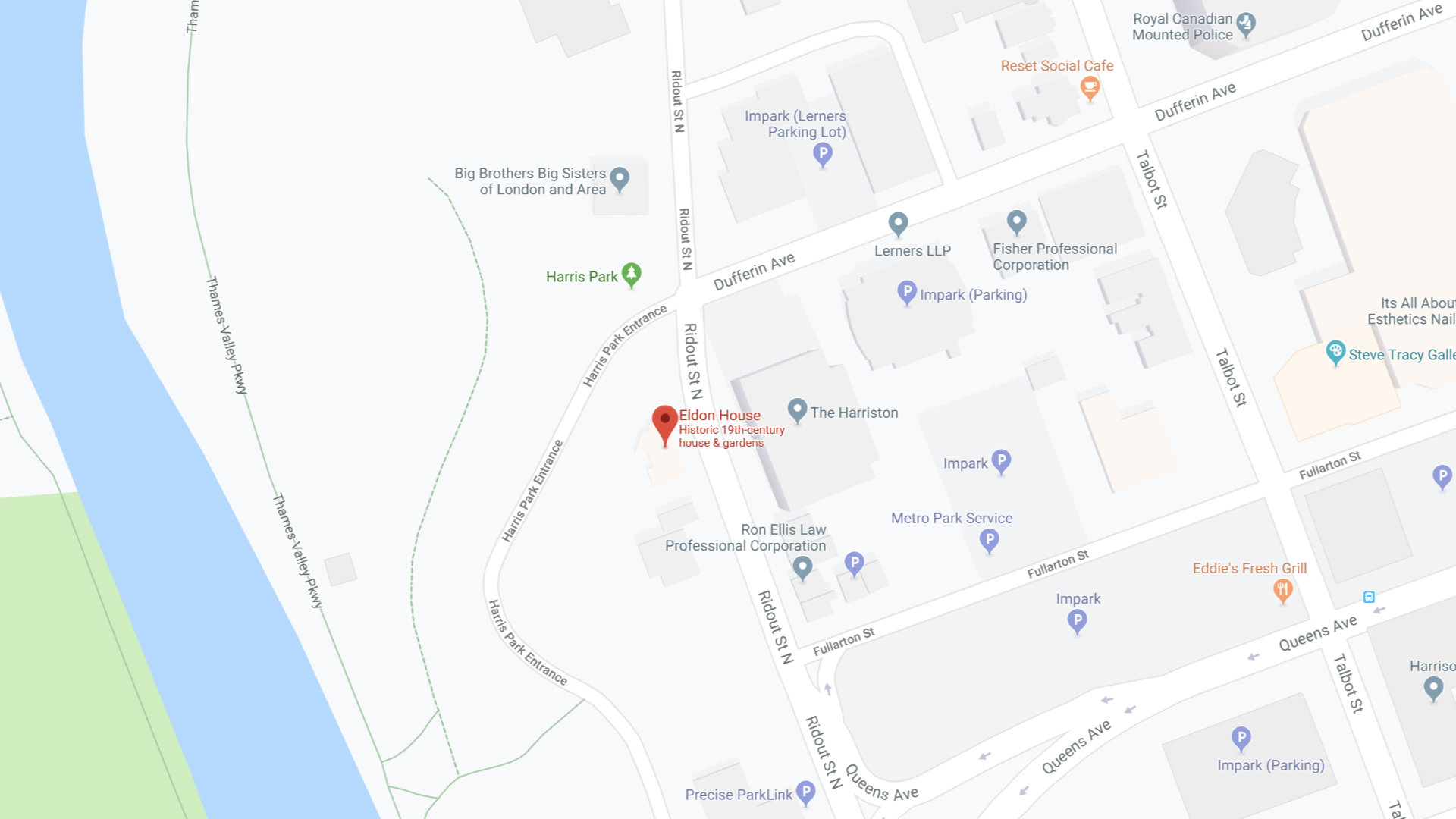
home on Ridout Street. Eldon House had been built in 1834 by John Harris who
settled in London at that time and became the Treasurer for the county. His
house was one of the first buildings erected in the new town of London, Ontario.
It had been targeted by Governor Simcoe as the future capital of Upper Canada.
Eldon House had housed Harrises ever since. The owners at the time of George 's
birth were George's father, Ronald, and his aunt, Milly, who never married. She
occupied the home until her death in 1959 at the age of 92.
George, Lucy and Robin grew up overlooking the forks of the Thames River and
Labatt Park which was situated on the opposite side of the river. They also
played in the flats below the house where a nine-hole golf course and swimming
pool were eventually to appear. The family's gardens and cows were situated to
the north of the house below the bank and on the flats, too. Their lives were
largely uncomplicated and privileged.
Ronald Harris was a mining engineer whose travels took him to various exotic
places and away from the family for long periods of time. Much of his life was
spent in West Africa. Lorna had a productive life as a mother and public servant
despite bouts of serious illness which incapacitated her from time to time. She
was tireless in her efforts during the run-up to the Second World War and while
her sons were overseas. All the children were schooled in London for their
elementary training. George attended Ridley College in St. Catherines, Ontario.
Lucy went to Miss Edgar and Miss Cramps School for Young Ladies in Montreal for
Grade 10 through secondary school graduation. Robin also attended Ridley.
Athletics and fitness were life-long interests for George Harris. He was a
middle handicap golfer and companion of Sandy Somerville who was later to become
his brother-in-law. Sandy was voted Canada's Golfer of the First Half Century
for his skills. Norah Lyle and George were married at the beginning of the war;
Sandy married Eleanor Lyle, Norah's sister in the mid-1940s.
George Harris served proudly in the Canadian artillery and saw considerable
action in the Italian Campaign. He fought at the Battle of Cassino in 1944 in
heavy fighting and distinguished himself with his bravery and valour. A story is
told of an incident in which he, at personal risk, commandeered a jeep to save
an injured colleague who was unable to retreat from heavy gunfire to the safety
of his camp. George was very concerned for his brother's safety. While older
brothers do care quite desperately for their siblings, George's worries seemed
to almost exceed those for his own safety. Robin and George both returned safely
to Canada at the end of the hostilities and resumed what might be considered
normal lives.
Adrienne was born in 1941; Lorna, named after her grandmother, was born in 1947.
The family lived in various residences in Toronto following the war. George was
retired from the Goodyear Tire Company in the early 1950s from employment he had
undertaken upon being mustered from the Armed Forces after the war.
George continued his abiding interest in golf. He maintained meticulous records
of the rounds he had played and with who he has shred those rounds. It was
disconcerting to be reminded of how poorly one had played three years before on
the same hole and on what day that had happened. He was long-time member of the
Royal Canadian Golf Association and part of the group which created the
prestigious Glen Abbey Golf Course in Oakville, Ontario, the home of the
Canadian Open for many years. He also was a member of the Canadian Seniors Golf
Association
Baseball was another serious interest. George, never known for his concentration
on mathematics, was, nonetheless, quick to work out batting averages. He
instilled the same interest in his sister who was able to work those matters out
long before she had mastered the 12 times table. George was smitten by the St.
Louis Cardinals. Luckily, Lucy chose the other league and the Detroit Tigers.
George was a knowledgeable fan and a purist; the Senior League was the only true
place where baseball was really played.
Lucy and George's rivalry was formidable. When a major league franchise was
awarded to Toronto, George was quick to get down to Exhibition Stadium in the
cold and snow of the winter to sit in a series of seats until he could choose
the place where the double play from second to first could be best observed. In
those early years, there were plenty of double plays for the games were high
scoring with many men on base. While not winning, there were many double plays
being turned. He was among the first of the Blue Jays ticket subscribers and
kept his tickets through thick and thin until baseball was something to which he
would no longer be able to attend.
That rivalry continued on the golf courses of the province. George was member of
the Royal and Ancient of St. Andrews Golf Club in St. Andrews, Scotland. He
regularly co-hosted a junket to Augusta for the third day of the Masters for
many years with his friend, the late Colin Brown. He also belonged to various
other courses from time to time including the London Hunt & Country Club and the
Toronto Golf Club.
George also fancied turtles and trains. There are other stories there. Not
enough space for everything, though.
George loved the arts and gave willingly of his time and support to such
institutions as the Stratford Shakespearean Festival, the Crest Theatre and the
National Theatre School. He also supported the Canadian Film Development
Corporation. He loved the theatre and artistic performances of all sorts despite
his grounding in athletic pursuits.
Upon the death of his aunt Milly, George and his brother and sister were faced
with the daunting task of attempting to deal with Eldon House and its
surrounding property. The house commanded a superior view of the forks of the
River Thames. It looked westward over the flats of London West to the hills of
Byron and Hyde Park. It had a superior view of the Canadian National Railway's
right-of-way which perched on the top of the river bank until crossing the river
to go west to Windsor or Sarnia. The dramatic and colourful sunsets regularly
reflected against its western face were no more impressive than the house was
itself.
Its lands included a large river flat and a bit of an oxbow which had been a
former millrace. Its upper grounds and the area around the lower pool were
well-kept and grassed. The swimming pool sat on the flats between the river and
the bank upon which the house itself sat. The house faced south and looked down
Ridout Street toward the County Court House. Eldon House's age alone would have
caught the attention of history buffs and those charged with heritage fervour;
however, its clean crisp lines, its general domination of its streetscape, its
landscaping and its colour made it also a cynosure to those without those
interests. Its inside configuration, its fixtures and furnishings, and its
historical and social context made it more than a simple house which could be
sold and the profits split. It needed more.
George, Lucy and Robin determined to gift the house and its grounds, and the
bulk of its furnishings, furniture, fixtures and household effects to the City
of London to be a living museum for its citizens. Mayor Allan Johnston could
barely contain his glee when accepting this generous gift from the three Harris
children. Eldon House continues to this day, 40 years later, as a lasting
monument to the life of the Harris family and the commitment of family members
to London, Ontario and its social and historical infrastructure.
At his funeral, George's two daughters presented their thoughts of the triumph
of their father's life. Deaths do represent an end to some things; it is often
hard to take a moral uplift from a sad occasion. When that happens, it is a
triumph for the deceased and those who love that person. Seth McLean spoke of
his remembrances. He realistically dealt with the sadness of the previous 10
years by stating quickly that they were an anomaly. Life before 80 contained the
salad days. His comment about George's dazzling good looks were emphasized by
the portrait which stood beside the alter.
Adrienne and Lorna provided point and counter-point to their father's life until
it was brought to the moment when George's four grandchildren, Kate and Justin, Maiga and Lyle brought to the piece its coda by sequentially reading a letter,
dated in 1944, that George had written to Norah from the depths and anguish of
the middle of Italy where atrocities and horror were its daily rhythm.
It is possible to take a lesson from this event. Many of us, not alive at the
time of the Second World War, might have forgotten the sacrifices that so many
made during those six years of strife and carnage. What these readings did was
to articulately and, without hyperbola, lyrically tell us the horror of the
event in the context of hope for the future. The names of the comrades-at-arms
whom George mentioned resonate with the history of which we all are a part. It
was as if the microcosm of that letter brought the macrocosm of the world's
unhappiness of the Second World War to its proper perspective.
George Harris did not likely think that his letter written in 1944 would prove
to be the star of his funeral. And one should not lose sight of the fact that
there was someone to whom the letter was written who can bask in the reflected
pride for happiness which George's life had brought to many. After all, if there
was not a recipient, there would be no letter.
Memories of Dr. Ronald (Robin) Sutton Harris, B.A.; M.A.; PhD.
Professor Emeritus, University of Toronto
October 27, 1919 to February 11, 2000
By Anthony Little
Ronald (Robin) Sutton Harris died on February 11, 2000. In his death, he was
survived by his second wife, Teresa, his brother, George, and his sister, Lucy.
He also left three children, Catherine, David and Mary. And Mary, in turn, had
four children.
That represents the base information which the obituary notices set forth.
The event itself was not a surprise. Robin had not been well for quite some
time. And he had not been himself for longer. That was a disappointment and a
bit of an irony. Here he was, with solid intellectual qualifications and
contributions, now in a nursing home in a diminished state.
Possibly, death was a relief? Well maybe relief is not the right word. An
ending?
But, there was another consequence, too: only a couple of Harrises left in the
line. David, his son, and George, his brother. More importantly, the Harris name
could not be extended. It was reaching its end.
David had no children and George, also in a nursing home, had bowed out of the
offspring sweeps a fair time ago -- with only two daughters on the credit side
of the successor ledger. So that was it. The name had reached the end of its
line. No more stations to sprinkle cinders and ashes into or smoke through.
That was a bit of a further irony.
The family's name had started with the birth of John Harris in 1782. His
parentage was clouded. Efforts had been made to get to the bottom of that
mystery. After all, it would be useful to find the line behind John Harris.
Apparently enquiries had been made -- to no avail. The Harris line seemed to
start with John Harris's birth. It was Lucy who had made the discovery.
Frustrated with the absence of a successful effort by her forebears to get the
definitive answer, Lucy had undertaken an investigation of parish records in the
area of John's reputed birth. Two centuries after John Harris's birth, on a solo
trip to the United Kingdom waiting to catch up with her husband for some further
travel, she had found the answer. It was in the area of Exeter where the
discovery was made.
There it was -- in the birth ledger of a small parish church. While John's
mother's name was there to be seen, in the column where his father's name should
have appeared, there was a single word "base-born". [Some might argue that to be
two words; however, the hyphen should be the answer to that criticism.] No
attribution. No named father. Certainly no named husband.
Lucy could hardly wait to get back with that nugget. Descendants of a bastard.
What a perfect irony!
You see, if the line had gone behind that entry, all sorts of sheep rustlers,
thugs and all around bad people might have been found to have contributed to the
gene pool. And then the rightfully assumed pride of ancestor-ship might have
been significantly diminished. As it was, one could, without argument, still
claim that the birth of John Harris represented the nine-month-later culmination
of a male of noble birth's dalliance with a woman of lower social standing. Once
the seed had been sown, as it were, there is no reason to think that Harris's
father might not have been someone of great social standing and power. One of
the George's perhaps? Certainly not the daffy one, George III. But one could
claim the two earlier George's as potential progenitors of the Harris line.
While one might have to accept that George I might well have been out of the
siring of children running by then, the point is that there is no evidence about
George II which could be considered definitive. We just can't be sure. So, the
tie should go to the runner (or, more poetically, the swimmer).
As Lucy proudly claimed: Descended from royalty we were! Despite the absence of
the evidence and the general trappings of the line.
As Lucy would have it, blood coursed firmly blue though all of our veins and
arteries -- clogged or unclogged as they may be. But for some quirk of fate and
unbridled unauthorized passion, we could be sitting in castles in England and
Scotland. Those Windsors might never have had to suffer the thrust and parry of
the British press -- had our parentage not been denied -- or obscured. No anis
horribilis as Mrs. Windsor put it.
Lucy might have had to swing her approach to lineage investigation to include a
lesser duke or earl (or even the Duke of Earl), had there been any evidence from
historical records which ruled out the actual kings. It seemed that royalty and
the friends of royalty were having their selfish ways in those days; there were
many incidents of royally connected persons whose fortunes were augmented
without attribution to parentage. And those individuals seemed to capitalize on
their misfortunes of birth to move to greater worldly fortunes and a winked-at
status known to the community in general.
But, in this case, it seemed that, since John Harris had decamped at an early
age into the British navy as a common seaman, the opportunity for there to be
available hard evidence was reduced. In the navy, Harris had joined Captain
George Bayfield and others in the New World in further naval-type pursuits.
Harris was certainly in Canada during the War of 1812. He was part of the
mapping activity, known as the Hydrographic Survey of the Great Lakes, which
delineated the extent and ownership of the Great Lakes. The names of his fellow
crew members were placed on many islands and ports. Moreover, the names of these
men also appear as the middle names of various descendants of John Harris. He
had also been Master of a number of ships which had plied the trade routes to
South America and Africa. Africa will ring a responsive chord later.
As Lucy would have it, his leaving took the true facts of his parentage out of
the public realm. Without a backward glance, John Harris, in the process, rose
from his common and simple beginnings and assumed increasingly higher ranks in
his naval pursuits. His exit rank was Master Seaman -- a designation which
allowed him to be known as Mr. Harris.
Ultimately, he married well. He eventually settled in London, Ontario. The story
of his courtship of Amelia Ryersie should get some consideration. As the story
goes, Harris was standing at the rail of the deck of Bayfield's boat as it
approached a dock on the south shore of Lake Erie -- apparently as part of its
charting of the Great Lakes-- activity. On the dock were a number of people --
including Amelia Ryersie. Amelia's forebears were staunch United Empire
Loyalists. Harris is said to have picked her from the dockside group and to have
announced to his crew-mates that he was to marry her and retire from his life on
the water. Two weeks later, he did that.
John Harris had taken his modest beginning to a position of power in his
community until his death in the mid-19th century. He became a prominent member
of the new settlement of London, Ontario, building a fine home which sat at the
forks of the River Thames, smack in the middle of Middlesex County overlooking
the River Thames. It would seem that John wanted to be near water despite his
departure from active naval pursuits. The fledgling settlement of London was so
perfect in its location (and with its assumed legitimacy of English place names)
that Governor Simcoe chose it to be the capital of Upper Canada. Muddy York,
(later Toronto) -- with its access to Lake Ontario -- later snuck that
designation away ... out from under the nose of John Harris who had become by then
a Judge of the Court of Quarter Sessions and the Treasurer of the District
before his death in 1848. The power base he had begun continued under the
leadership of his widow and their children for the balance of the century
although the financial fortunes of the family had their ups and downs.
So the Harris line has had a pretty good run for the better part of 225 years.
And Robin his sister Lucy and his brother George continued the run by donating
the family's home, Eldon House, built in 1832, its contents and its surrounding
(and sizable) acreage, to the citizens of London in 1960 when the last resident,
Amelia Archange Harris, a spinster, died.
Museum London, on behalf of the City of London, runs the home as a museum and
its grounds have become a park used as a focus and location for many civic
events.
Robin's father, Ronald, was a taciturn red-headed man who had graduated from the
Royal Military College in Kingston as an early number and had then attended
Houghton Engineering College in the Upper Peninsula of the grand State of
Michigan. Houghton, Michigan was on the south shore of Lake Superior. Ronald
Harris's fortunes took him around the world. He was imbued with the travel bug
for which the family had become famous. For example, for much of his
professional life, he was found in West Africa where he worked as a Mining
Engineer with Cecil Rhodes.
(Ronald's time in Africa may have become a later example for Robin who spent
some time on the same continent in Sierra Leone as a consultant on educational
matters. When that country achieved its independence, Robin assisted in the
creation of its educational system. The Africa thing may go all the way back to
John Harris's experiences as a Master Seaman on Africa-bound ships. More on the Sierre Leone connection later.)
Other examples of Ronald's peripatetic existence: On his honeymoon, Ronald and
his new bride were found in Bolivia where Lorna, not particularly known for her
culinary skills, found it perplexing that a three-minute egg took 12 minutes to
cook because of the elevation. When his second child, Lucy, was born, Ronald was
in Juneau, Alaska. In fact, he did not see Lucy until after her second birthday.
Robin's mother, Lorna Harris (nee Gibbons), was a formidable power in her own
right. She was the daughter of George Gibbons, later to be knighted for his work
in bringing independence to Canadian foreign affairs through the negotiation of
the Boundary Waters Treaty of 1909 with the United States and the subsequent
creation of the International Joint Commission -- an institution created to deal
with American-Canadian matters of mutual interest and concern which related to
their joint boundaries. That institution survives to the present day. The
relevance of that institution has become even more obvious in the present
context -- as we face issues of water availability, the lowering of the levels of
the Great Lakes and issues of cross-border pollution.
(The linkages with John Harris's early work on the Great Lakes with Bayfield do,
perhaps, also become obvious?)
Lorna was independent and fiercely protective. She, nonetheless, had some
medical difficulties which took her from the running for various prolonged
periods. She did, however, find time to run Eldon House (perhaps in competition
with her sister-in-law, Milly, who remained a co-owner with Ronald). She also
served as the first female member of the Board of Education for London and
became its first woman chairperson.
Around the time of Robin's birth, Lorna was ill. She and Ronald spent
approximately three years in Baltimore, Maryland dealing with Lorna's illness.
It would seem that Lucy and Robin were raised by their aunt, Milly, and the
various people who helped in the running of Eldon House. And that may explain
the affection that all of the three children had for each other.
Robin went firstly to Lord Roberts Public School and then to Empress Avenue
Public School. At Empress, he was part of a new experiment in education. The
plan was to take identified intellectually gifted students from their home
schools in London and to place them under the tutelage of two experienced
teachers for Grade 5 through Grade 8 at Empress and to expose them to higher
levels of curriculum and activities. Robin was, apparently in the first class.
He is reputed to have been, in the estimation of Edna Lancaster, the brightest
student she had.
From there, Robin followed his brother, George, to Ridley College in St.
Catharines, Ontario. His academic prowess there did seem to be favourably known.
Robin continued in his education at the University of Western Ontario and then
at the University of Michigan from which he was granted a Doctoral Degree in
English and Education.
He married Patricia Gunn. They had the three children who are identified in the
opening paragraphs. He worked in London at the University of Western Ontario
until gaining an appointment to the Faculty of the University of Toronto in the
English Department.
Robin presented two personae: to his colleagues he was an academic with solid
credentials with a dedication to service in the university community and a
contributor to the development of scholarly works. He wrote and published. A
particular interest was education in Ontario and the study of the work of
Egerton Ryerson. Ryerson was a cousin of Amelia Harris. (We seem to keep
doubling back on the linkages to the Great Lakes and John Harris.)
The other version of Robin was of a slightly fey, absent-minded, athletic
individual who seemed to like a good time and to be in good company. In that
latter regard, he was again following the footsteps of his brother, George, who
had a similar conviviality, a similar interest in athletics -- baseball and golf,
in particular -- and a similar fondness for general happiness. Robin's family
would not agree with the fey description. On the other hand, Robin's
brother-in-law, Lucy's husband, Frank, would have said he was the mould. It was
Frank who wrote the two stanza doggerel commemorating Robin's sojourn to West
Africa.
Bingo, bango, bongo,
Uncle Robin's in the Congo
With Sarah (sic) Leone.
Bingle, bangle, bungle,
Uncle Robin's chasing round the jungle
After Sarah (sic) Leone.
Robin would come to visit. On his departure, there would be forgotten razors,
sweaters, scarves, house keys, mushed-up newspapers, discarded books, abandoned
and partly edited manuscripts of arcane literary efforts and, on one memorable
occasion, a missing kitchen carving knife -- 14 inches long. The process for the
delivery (or return) of forgotten (or purloined) paraphernalia would occupy the
next number of days. All of this baffled Frank who seemed to be found, on more
than one occasion, shaking his head as Robin swept up and out the lane and past
the Virginia Gate in whatever mud-besplattered and dinted vehicle he had chosen
for that particular trek.
Robin served on the Board of Education for the City of Toronto. He had
undertaken a change of name application to secure success. He was of the opinion
that Ronald -- his legal, christened name -- would not get the public attention it
would need. His thought was that he would have to get back to the name that he
had enjoyed through his mortal existence. So whatever was necessary was done to
ensure that he was Robin on the ballots. He was right -- it would have seemed --
for he was elected twice under that name.
He was Acting Principal of University College at U of T. He was the first
Principal of Innes College at the same university. The University of Western
Ontario awarded him an Honourary Degree in 1982. Ryerson did the same thing.
(And, surely, that was a neat bit of circle closing.)
In retirement, he wrote a book on the Harris Family papers with his wife, Terry.
That book was published by the Champlain Society. He continued to work with the
Harris papers until his last illnesses made that impossible.
Robin's family determined that his passing should be observed with a style and
grace -- befitting of his energies during his lifetime. In the result, there was
a service in Richmond Hill -- two or three days after his death -- at which a
number of friends and relatives were in attendance. At that service, Reverend
Pat Orr presided. Pat was also a student at Ridley College although he claims to
be much younger than Robin. Catherine, David and Mary all played roles in the
service. David read a lesson; Mary presented a couple of prayers from a famous
church in Boston which is located on Copley Square; and, Catherine presented a
homily. In speaking of her father, Catherine presented a balanced and warm
recollection of her father's interests and background.
After the ceremony, many of those in attendance repaired to the basement of a
nearby restaurant for a period of reminiscence. This event started a train of
similar events which provided an opportunity for those present to relearn their
connective links as well as to enjoy themselves in convivial surroundings. The
noise level at this event increased as the time went by and more joined the
fray. In fact, the availability of strong drink may have aided that development.
It never approached a revel standard. Nonetheless, the event took some
proportions of a wake. No one seemed hesitant or apologetic in that endeavour.
There was then a slight break to allow energies to recover and reflections to
continue until the next onslaught of funeral-related activity. That next level
was more concentrated and took place in the last weekend of April.
The Friday event was a Memorial Service at Innes College at 4:00 pm. The weather
was fortunate for the event. A sunny spring day. The service took place in what
is described as the Town Hall. A series of thoughtful speeches were presented.
The speakers, John Fraser, David King, Johan Aitken, Derrick de Kerckhove, Jack
Dimond and Adrienne Harris all gave a different slant on Robin and his role in
their (and our) lives. They seemed to be joined in their presentations by
certain common threads. One actually claimed a connective link. All expressed
bemusement at their personal recollections of eccentricities which they felt
Robin to have had. One seemed to work within a thesis that Robin's CV had been
subject to omission although all seemed to agree that he had a very full life.
After the service, the assembled group moved inside and outside in a quadrangle
attached to a lounge where happy conversations developed. Again the common
thread was to find the linkage between Robin's family activities and
professional activities.
The next event was the actual Interment Ceremony at Woodlawn Cemetery in London,
Ontario. Again Pat Orr presided. Mary Harris presented the same prayers which
she had read at the Funeral Service in Richmond Hill. This day was a warm, sunny
afternoon with some early foliage developing on the trees and some wild flowers
in the emerging grass. Robin's sister, Lucy was present. The mood was mellow.
There was a life to the event and to the people present which seemed to be
reflective of Robin's life in its own way. Everyone seemed reconciled to the
fact that, in this ceremony, we were signalling an end to a useful life; but,
that we, as participants, were also going onwards -- positively and happily.
Following this event, some went to have a luncheon at a nearby restaurant which
overlooked the Thames River beside which Robin had played many years ago in his
youth at Eldon House. Water again. That evening, there was a successful
gathering at the home of Tony and Betsy Little.
The events and developments of Robin's life represent the culmination of many
events which draw upon the early historical development of his family and
continue that family's public-spirited approach to life in a very real and
palpable fashion. Robin and his brother and sister would not describe themselves
as owners or creators. If pushed, they might allow to personal responsibility
for certain creations and contributions; however, they would explain those as
having been unintentional, felicitous or the result of plain, good luck. Each
would attempt to have downplayed personal involvement. They would more happily
describe themselves as stewards of a legacy for which they were bound -- because
of the good fortune of their births -- to move positively forward. That
obligation would prevail during the period of time the legacy was in their
hands. And they would also be charged with a responsibility to make certain that
their own individual followers were imbued with the same sense.
In the result, while Robin's death is an end to his own life, his life is an
example to others. And to members of his family -- whether not they actually
carry the Harris name.
His spirit of public involvement and contribution will, no doubt, continue.